
Check Kafka partition leaders and in-sync replicas
Read partition leaders, replicas and ISR with kafka-topics.sh and kcat, find under-replicated or leaderless partitions, and avoid advertised listener traps.
Guides for inspecting databases and clusters safely, comparisons with other tools and engineering notes from the DevOpsPad team.
Read partition leaders, replicas and ISR with kafka-topics.sh and kcat, find under-replicated or leaderless partitions, and avoid advertised listener traps.
A read-only flag in a client is not a permission boundary. Create a MySQL account that can only SELECT, scope it to one schema and verify the grants.
Ansible automates any host task over SSH with playbooks. DevOpsPad offers a narrow set of reviewed actions for K3s Deployments and Nginx configs, with records.
Argo CD continuously syncs clusters from Git with a controller in each cluster. DevOpsPad releases from your desktop with a dry-run plan, a lease and a record.
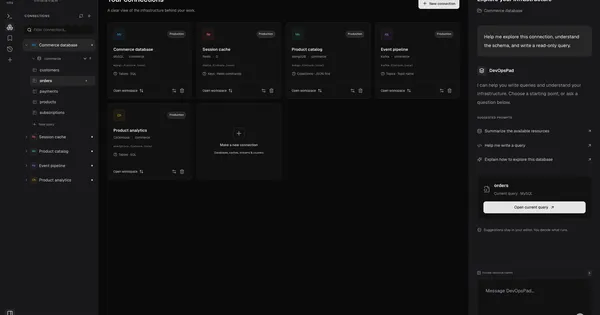
DBeaver Community is a free, cross-platform SQL client with hundreds of JDBC drivers. DevOpsPad covers fewer engines, is read-only and adds Kubernetes.

k9s is a fast terminal UI that can edit, exec and stream logs on any resource. DevOpsPad is a read-only desktop explorer with databases and SSH tunnels.

Lens is a full Kubernetes IDE with editing, terminals and Helm. DevOpsPad is a read-only cluster explorer with databases, SSH tunnels and reviewed releases.

Navicat is a mature database IDE for editing, modeling and syncing SQL databases. DevOpsPad is a read-only workbench that also covers Kafka and Kubernetes.

How DevOpsPad releases from a laptop with no server: single-use plans, server-side dry-run, a Lease per Deployment, resourceVersion checks and honest results.
A namespace Role that can read Pods, logs, events and Deployments but not Secrets or anything writable, a ServiceAccount token kubeconfig, and how to verify it.

skip() gets slower with every page and shifts when data changes. Range queries on an indexed sort key stay fast. When to use each, with Extended JSON examples.

Three ways to use kubectl against an API server that only a bastion can reach, how TLS server names break, and how a tunnel-aware client avoids it.
When a Pod restarts, kubectl logs shows the new container. How to get the previous instance's logs, exit code and events, and what to do when they are gone.
KEYS walks the whole keyspace in one blocking call. SCAN pages through it. How to use SCAN correctly and how to lock KEYS out of a read-only Redis ACL user.

Tags can be moved; digests cannot. How to find an image's sha256 digest, deploy by digest, handle multi-arch indexes and roll back to exactly what ran before.
Query ClickHouse over HTTP with readonly, result limits and timeouts, then enforce them on the server with a SELECT-only user and a settings profile.
The GitHub Actions workflow that builds, signs, notarizes and staples the DevOpsPad macOS app, CLI and DMG, including a temporary keychain and stapler retries.
How DevOpsPad sends database and Kubernetes traffic over in-process SSH channels, with no local port, no direct fallback and strictly verified host keys.
How DevOpsPad splits connection metadata from secrets, keeps the keychain and workspace.json consistent on failure, and refuses to fall back to plaintext.

Run an OpenAI-compatible model on your own machine with Ollama, LM Studio or llama.cpp, test the endpoint with curl, and point a desktop SQL client at it.